
Cursor Adoption and Its Effect on GitHub Impact Metrics for ICs

Cursor Adoption and Its Effect on GitHub Impact Metrics for ICs
Something curious is happening to GitHub contribution patterns. As AI-assisted coding tools gain adoption, the quantitative signals we've relied on for years are shifting in ways that make evaluation harder — and arguably more interesting.
Cursor, the AI-powered code editor built on VS Code, has become the poster child for this shift. But the implications extend far beyond a single tool. For anyone who uses GitHub activity as a hiring signal, understanding these dynamics is now essential.
The Productivity Paradox in Contribution Graphs
When an IC adopts Cursor or similar AI tools effectively, their GitHub footprint often changes in counterintuitive ways.
Commit frequency may drop while lines changed per commit increase. Pull requests might become larger and more self-contained. The time between opening and merging PRs can shrink dramatically, but total PR count might decrease as developers tackle problems they previously would have broken into phases.
This creates a measurement problem. A developer who previously made 15 commits across 3 PRs to implement a feature might now ship the same work in 2 commits and 1 PR. Their commit graph looks less active. Their contribution count drops. But their actual output hasn't changed — and may have increased.
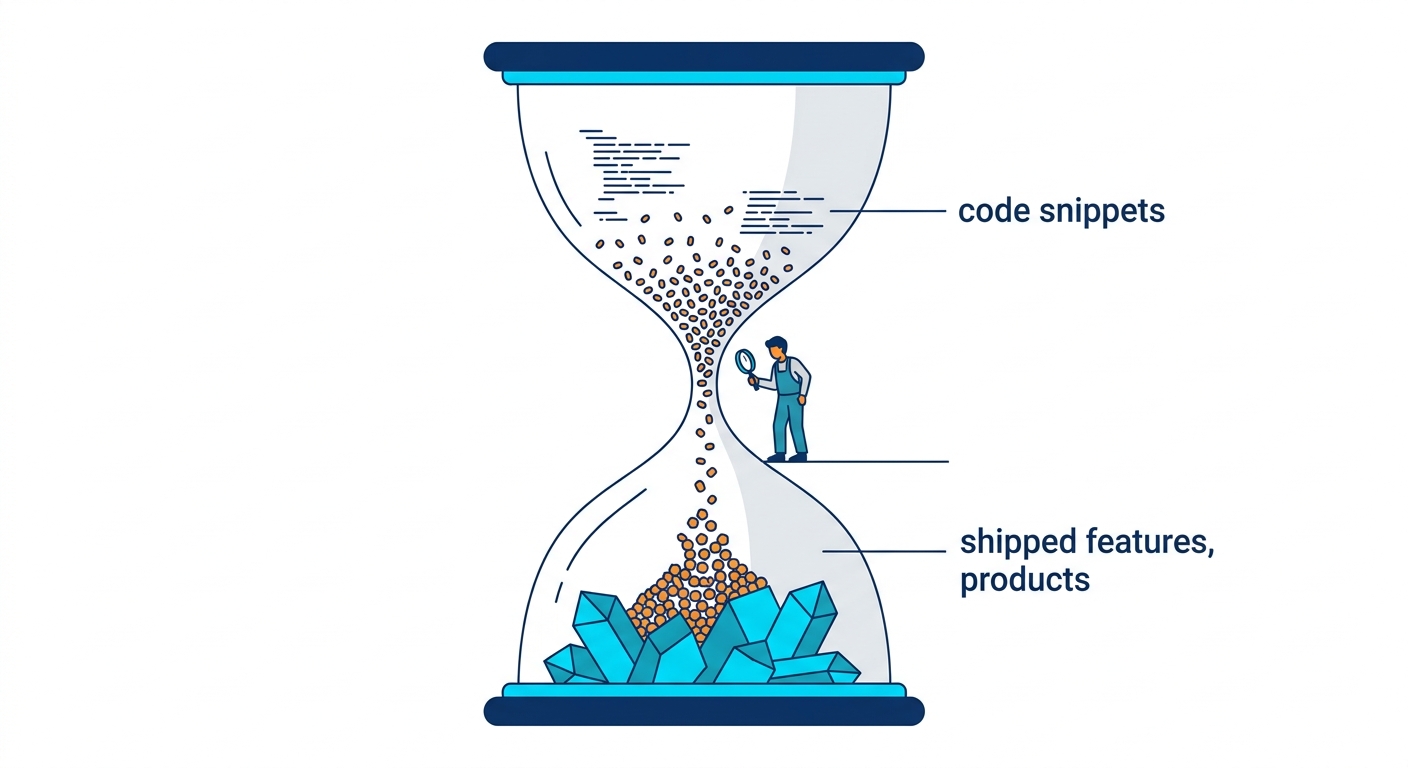
Traditional metrics like streak length, commit frequency, and raw contribution counts become less reliable as signals when AI tools compress the visible work into fewer, denser artifacts.
What Actually Changes With AI-Assisted Workflows
The effects vary significantly based on how developers integrate these tools:
Code generation shifts the bottleneck. When writing boilerplate takes seconds instead of minutes, the limiting factor becomes architecture decisions and review cycles, not raw coding time. This often shows up as longer gaps between commits but more substantial changes in each.
Test coverage patterns change. Developers who previously skipped tests due to time constraints now generate comprehensive test suites because the marginal cost dropped. You might see test-to-code ratios spike for certain contributors — a genuinely positive shift masked by aggregate commit metrics.
Documentation and comments increase. When explaining your intent to an AI becomes part of the workflow, that context often ends up preserved in the codebase. This is valuable signal that doesn't show up in contribution graphs at all.
The Evaluation Challenge for Engineering Leaders
If you're using GitHub profiles as hiring signals — through tools like GitDex or manual review — the AI adoption question adds a layer of complexity.
A declining commit frequency in late 2023 onward might indicate reduced productivity. Or it might indicate effective AI tool adoption. The metric alone can't tell you which.
What starts to matter more:
Quality of individual contributions over quantity. PR descriptions, architectural decisions visible in code structure, and the sophistication of solutions become more important than raw activity counts.
Repository diversity and scope. Developers using AI tools often become more willing to contribute to unfamiliar codebases because the onboarding cost drops. Cross-repository contribution patterns may actually become a stronger signal.
Commit message and documentation quality. When developers spend less time on implementation mechanics, the attention often shifts to communication. Look for evidence of that shift.
Rethinking Impact Metrics
The most useful response isn't to dismiss GitHub metrics or over-correct for AI assistance. It's to treat quantitative signals as conversation starters rather than conclusions.
A developer with sparse recent activity but high-quality, architecturally significant contributions may be more valuable than one with a dense commit graph of routine changes. The difference is harder to detect automatically but easier to spot in review.
For platforms that aggregate developer reputation signals, this means the weighting of different metrics needs to evolve. Influence in open-source ecosystems, depth of engagement on significant projects, and the quality arc of a developer's work over time all become relatively more important as raw activity counts become less reliable.
The tools are changing what gets measured. The underlying capabilities they're trying to measure haven't changed at all.